Compliance Mapping Made Simple: A Guide for Startups
Compliance Mapping Made Simple: A Guide for Startups
Compliance mapping can save startups time, money, and resources by aligning regulatory requirements with existing tools and systems like AWS, GitHub, and CI/CD pipelines. It’s crucial for securing enterprise deals, passing due diligence, and meeting customer expectations. Startups often spend £75,000–£190,000 annually on manual compliance efforts, with audits taking up to 500 hours. Automating this process reduces costs and keeps teams focused on growth.
Key frameworks - SOC 2, PCI DSS, and ISO 27001 - overlap significantly, allowing for streamlined compliance efforts. For example:
- SOC 2 builds trust with North American clients.
- PCI DSS protects payment card data and is mandatory for businesses handling credit card payments.
- ISO 27001 certifies global information security management systems, widely respected in Europe.
Startups can simplify compliance by:
- Identifying applicable frameworks based on client needs.
- Reviewing infrastructure to find gaps.
- Creating a unified compliance map to cover multiple frameworks.
Automation tools like Nuvm, Prowler, and Checkov integrate compliance into development pipelines, reducing manual work and ensuring continuous monitoring. By embedding compliance into daily workflows, startups can reduce disruption, meet regulatory demands, and scale efficiently.
Mastering Control Cross-Mapping for Enhanced Compliance
sbb-itb-5d9b290
Key Regulatory Frameworks: SOC 2, PCI DSS, and ISO 27001
SOC 2 vs ISO 27001 vs PCI DSS Compliance Framework Comparison
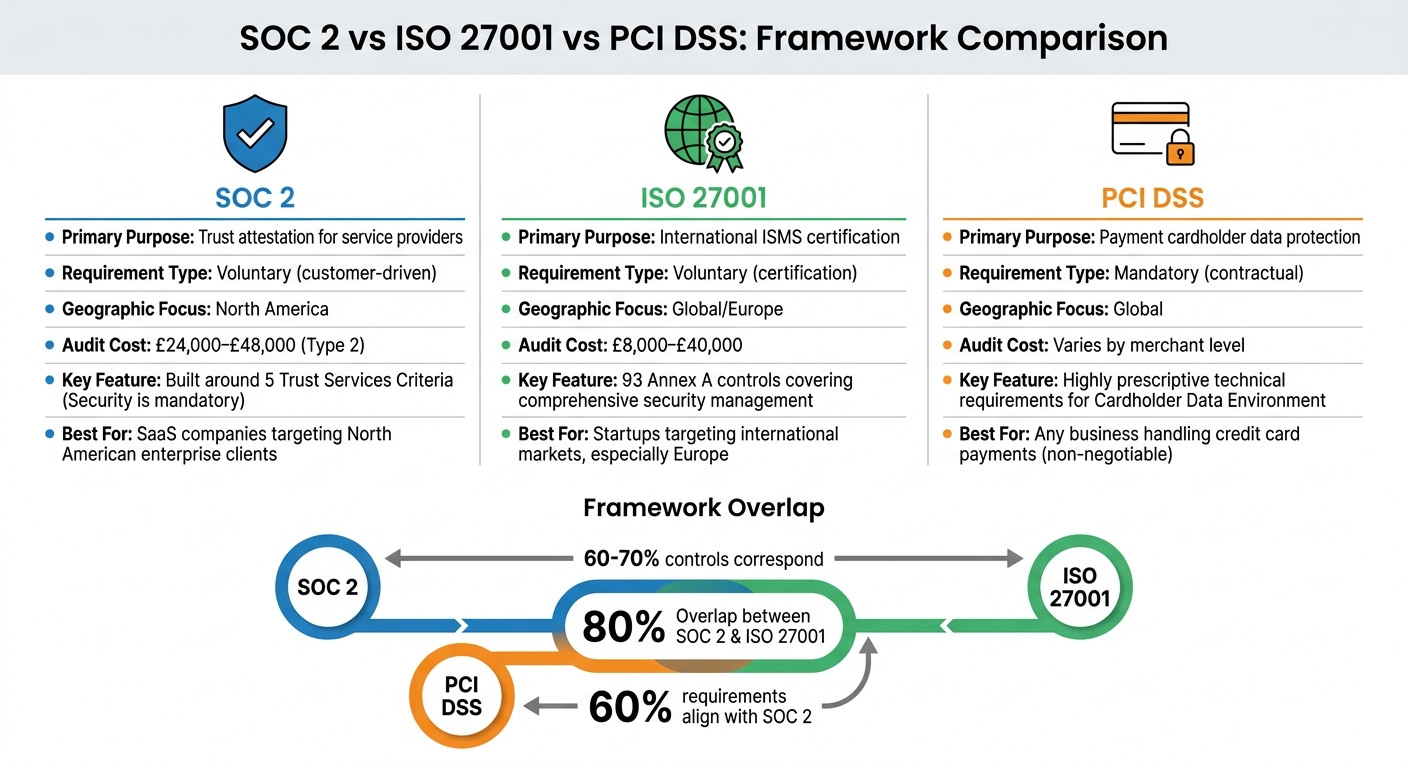
Before diving into compliance, it's crucial to understand what each framework requires. Many of these standards overlap - for instance, about 60% of PCI DSS requirements align with SOC 2, and 60–70% of SOC 2 controls correspond to ISO 27001. This overlap can make it easier to expand your compliance efforts across multiple frameworks.
However, the purpose of each framework is distinct. As Hicomply explains:
SOC 2 = build trust with customers. PCI DSS = keep your ability to accept credit card payments
SOC 2 has become a must-have for SaaS companies catering to North American enterprise clients. It’s no longer an optional extra but an essential requirement for B2B startups. Meanwhile, ISO 27001 is the globally recognised standard, particularly valued in Europe, and focuses on implementing an Information Security Management System (ISMS). On the other hand, PCI DSS is mandatory for businesses that handle payment card data.
Here’s a quick comparison of the three frameworks:
| Framework | Primary Purpose | Requirement Type | Geographic Focus | Audit Cost |
|---|---|---|---|---|
| SOC 2 | Trust attestation for service providers | Voluntary (customer-driven) | North America | £24,000–£48,000 (Type 2) |
| ISO 27001 | International ISMS certification | Voluntary (certification) | Global/Europe | £8,000–£40,000 |
| PCI DSS | Payment cardholder data protection | Mandatory (contractual) | Global | Varies by merchant level |
These frameworks form the foundation for aligning technical controls with regulatory requirements, especially in cloud-driven environments.
SOC 2: Trust Principles for SaaS Companies
SOC 2 is built around five Trust Services Criteria: Security, Availability, Processing Integrity, Confidentiality, and Privacy. Among these, Security is the only mandatory criterion, meaning most startups automate SOC 2 compliance during their initial audit to save time and reduce costs.
SOC 2 audits come in two forms:
- Type 1: Evaluates whether controls are appropriately designed at a single point in time.
- Type 2: Assesses the effectiveness of controls over a period, typically 6–12 months.
While a Type 1 report is a good starting point, enterprise clients generally prefer the more robust Type 2 report. These audits are performed by Certified Public Accountants (CPAs) and result in an attestation report rather than a straightforward pass/fail outcome.
For SaaS startups, achieving SOC 2 Type 2 compliance is often a stepping stone to establishing trust and unlocking enterprise-level opportunities.
PCI DSS: Protecting Payment Card Data
PCI DSS offers a detailed, technical framework enforced by the PCI Security Standards Council. It applies to the Cardholder Data Environment (CDE) - systems that handle credit card data. Version 4.0 of PCI DSS includes specific requirements such as:
- Passwords of at least 12 characters (or 8 with multi-factor authentication)
- Session timeouts set to 15 minutes
- Audit logs retained for 12 months, with 3 months of logs readily accessible
Unlike SOC 2’s risk-based approach, PCI DSS is highly prescriptive, leaving little room for interpretation. Audits are conducted by Qualified Security Assessors (QSAs).
For startups in payment processing, PCI DSS compliance is non-negotiable - it directly affects the ability to manage card transactions.
ISO 27001: Building an Information Security Management System
ISO 27001 focuses on creating a comprehensive ISMS, incorporating 93 Annex A controls that cover everything from access management to incident response. This globally recognised framework is especially useful for startups targeting international markets or clients outside North America.
The certification process involves an accredited registrar and follows a three-year cycle with annual surveillance audits. While ISO 27001 audits are often 1.5–2× more expensive than SOC 2, the overlap between the two (around 80%) allows businesses to reuse many controls and evidence across both frameworks.
For startups aiming for a global presence, ISO 27001 not only enhances credibility but also builds on existing SOC 2 compliance to open doors in Europe and beyond.
How to Map Your Compliance Requirements
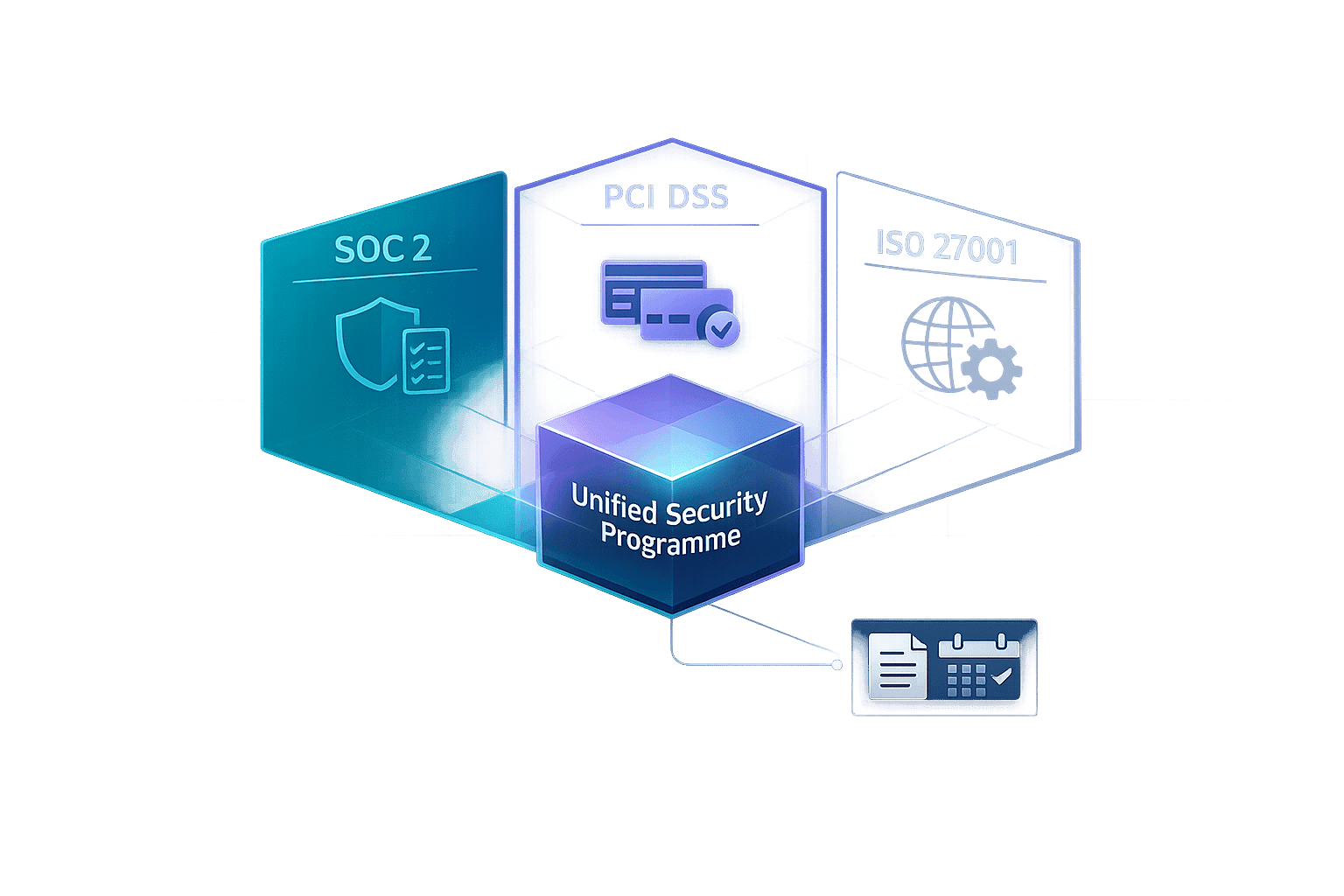
Mapping your compliance requirements doesn't have to be complicated. The trick lies in creating a single, cohesive security programme and aligning it with the various frameworks your customers or regulators might require. Start with one solid security programme and then adapt it to meet specific needs.
Here’s how to turn compliance mapping into actionable steps.
Step 1: Identify Which Regulations Apply to Your Startup
The first step is figuring out which regulations or certifications apply to your business. A good place to start is by reviewing customer questionnaires and contracts, especially from your biggest or most strategic prospects. These often specify the certifications they expect.
For SaaS companies targeting North American enterprises, SOC 2 is usually the most practical starting point. For European or global clients, ISO 27001 tends to be the standard choice. If your business processes credit card data, PCI DSS is non-negotiable, no matter your size.
With 67% of organisations citing regulatory compliance as a driver for security spending, understanding the frameworks that matter to your target market is essential.
Step 2: Review Your Infrastructure and Find Gaps
Next, take a close look at your existing infrastructure. Create a comprehensive list of all production systems - this includes your cloud providers (e.g., AWS, GCP), code repositories (e.g., GitHub), identity providers (e.g., Google Workspace), and HR systems. Conduct a thorough scan of your codebase and infrastructure to spot vulnerabilities or misconfigurations.
Focus your initial efforts on high-priority areas such as Access Control, Audit and Accountability, and System and Communications Protection.
To evaluate your current security measures, use a four-tier scale:
- Not in place
- In place but not effective
- Effective but not provable
- Effective and provable
As Muhammad Irfan points out:
A policy without a working control is just aspirational fiction
Ensure your controls are backed up by system logs, not just documentation.
Step 3: Build a Unified Compliance Map
Instead of tackling each framework as a separate task, aim to create a single, unified control library. For instance, implementing multi-factor authentication can simultaneously meet requirements for ISO 27001, SOC 2, PCI DSS, and NIST. This approach streamlines audits and speeds up your compliance process.
Ali Aleali, Co-Founder at Truvo Cyber, explains:
This is the single most important architectural decision in compliance: build the programme first, then map frameworks onto it
Once your security programme is in place, adding a new framework becomes much easier - requiring only 20–30% additional effort compared to starting from scratch. Assign clear ownership for each control to ensure accountability. This method can significantly cut down the 300–500 hours spent annually on audit preparation and save a chunk of the £75,000–£190,000 in compliance costs previously mentioned.
Tools and Templates for Compliance Mapping
Once you've created your unified compliance map, the next step is finding the right tools to streamline evidence collection and cut down on manual work. By combining open-source scanners with specialised platforms, you can automate much of the compliance process. These tools integrate directly with your compliance map, making evidence collection faster and more efficient.
Open-Source Tools for Scanning and Evidence Collection
Open-source tools are a cornerstone of compliance automation. For example, Prowler is an AWS security scanner that checks compliance with frameworks like SOC 2, PCI DSS, ISO 27001, and GDPR. It's especially handy for startups that rely heavily on AWS and want to avoid being tied to specific vendors.
If you're working with Infrastructure as Code (IaC), Trivy scans for vulnerabilities, misconfigurations, and secrets across containers and Terraform files, while Checkov provides similar functionality with built-in policies mapped to CIS benchmarks. For teams operating across multiple cloud providers, ScoutSuite audits AWS, Azure, and GCP simultaneously, flagging misconfigurations that could lead to compliance issues.
To manage compliance results, Auditree offers version-controlled storage, and Comply simplifies SOC 2 documentation by using markdown templates. Together, these tools significantly reduce the time and effort needed for audit preparation.
Compliance Automation Platforms
While open-source tools handle scanning and data collection, automation platforms bring everything together into one dashboard. These platforms connect with your cloud providers, identity systems, and HR tools via APIs, automatically pulling timestamped evidence and eliminating the need for last-minute screenshot gathering before an audit.
For example, Nuvm integrates nine scanners, including Trivy, Prowler, and Checkov, into a single dashboard. It tags each issue with the relevant SOC 2, PCI DSS, or ISO 27001 control, removing the need for manual mapping. This is a game-changer for small teams without dedicated security engineers, as it enables continuous monitoring in just minutes. Plus, Nuvm provides plain-English remediation advice for every finding.
Continuous monitoring offers a significant advantage over periodic audits. Manual processes often uncover compliance gaps weeks or even months after they occur. In contrast, automated platforms can detect issues within minutes. This real-time insight not only reassures auditors about the reliability of your controls but also saves teams from the 4–8 weeks of disruption that typically come with manual audit cycles.
Ready-Made Templates for SOC 2, PCI DSS, and ISO 27001
Once you've automated evidence collection, pre-built templates can make the compliance process even smoother. Platforms like Vanta, Drata, and Secureframe provide ready-to-use control libraries that link your internal practices to framework requirements. For instance, a single IAM least-privilege policy can simultaneously fulfil SOC 2 CC6.1, ISO 27001 A.8.9, and NIST AC-6 requirements.
A Security Programme Manual acts as your operational guide, detailing how each security domain operates, who is responsible, and the schedule for related activities. These templates can be customised further by using policy-as-code - expressing technical policies in YAML or JSON. This automation not only keeps policies version-controlled but also ensures they execute consistently. This approach is particularly efficient, as 60–70% of SOC 2 controls align directly with ISO 27001 requirements, allowing you to repurpose much of your work across frameworks.
Scaling should always reflect your specific needs. For instance, a SaaS startup will require far fewer physical security measures than a hardware-focused business. Tailoring templates to match your risk profile ensures you're addressing the right priorities instead of rigidly following generic checklists.
Compliance Workflows for Cloud-Native SaaS Teams
Example: Mapping SOC 2 Controls with Nuvm
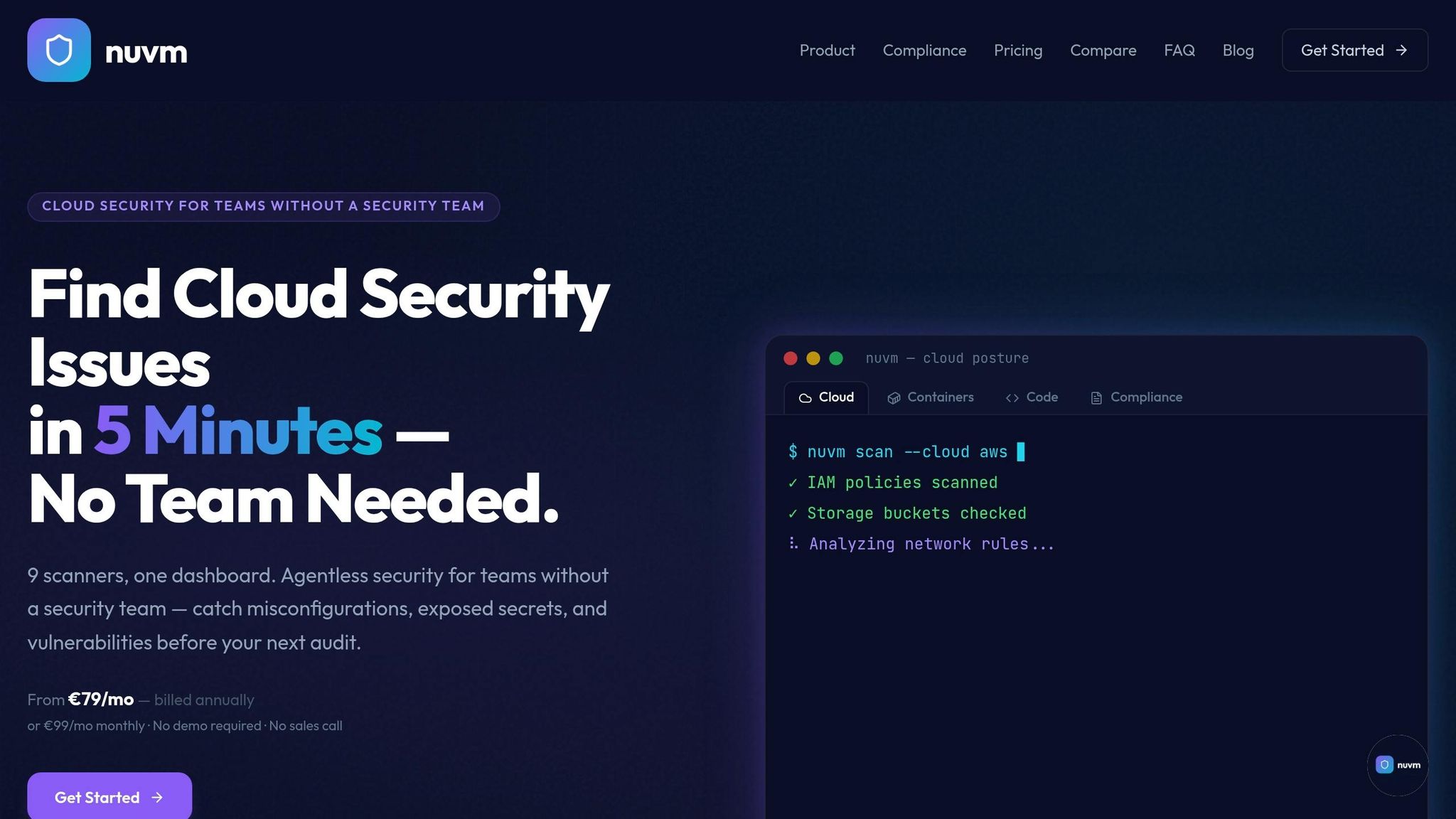
Start by defining your audit scope. For most SaaS startups, this usually means concentrating on the Security criterion (a required component) and possibly adding the Availability criterion if you've committed to uptime SLAs. Once you've identified the relevant Trust Services Criteria, connect Nuvm to your AWS, GCP, or Azure accounts using read-only API credentials. From there, Nuvm conducts a gap analysis across its nine integrated scanners, flagging issues like publicly accessible S3 buckets or overly permissive IAM roles.
All findings are displayed on a unified dashboard, clearly linked to the applicable SOC 2 controls. This eliminates the tedious task of manually cross-referencing spreadsheets. For example, if Prowler identifies an unencrypted RDS instance, Nuvm will map it to CC6.7 (encryption requirements) and provide straightforward remediation steps in plain language. With continuous monitoring, configuration drift is detected within minutes, reducing the need for prolonged manual audit cycles.
This setup also allows you to reuse controls across multiple compliance frameworks, cutting down on duplicated work. For instance, a single IAM least-privilege policy can simultaneously address SOC 2 CC6.1, ISO 27001 A.8.9, and NIST AC-6. This kind of mapping naturally integrates into your ongoing development and security practices.
Adding Compliance to Your CI/CD Pipeline
Once you've automated SOC 2 mapping, the next step is incorporating compliance checks into your development workflow. This builds on the unified compliance mapping approach, creating a cohesive security strategy. You can integrate compliance directly into your GitHub workflows using policy-as-code. For instance, set up pre-commit hooks to scan Terraform files with Checkov before merging code into the main branch. This can block deployments that introduce risks like disabled CloudTrail logging or missing VPC flow logs. Catching these issues during pull requests makes remediation quicker and less disruptive.
Additionally, use tools like Trivy to scan container images during your CI/CD process. Builds can be configured to fail if critical vulnerabilities or hardcoded secrets are found. Pipeline logs can be connected to Nuvm's evidence collection system, capturing immutable audit trails such as approved pull requests, reviewer sign-offs, and deployment timestamps. As Andrios Robert from Hoop.dev aptly puts it:
A failed build at 2 a.m. is problematic. A failed audit because you can't prove what happened in your CI/CD pipeline is worse.
To avoid overwhelming your team with alerts, configure gates that prioritise high-severity violations. For example, you can categorise low-risk issues while ensuring engineers are alerted only for critical problems, such as production databases without encryption. By embedding compliance into your CI/CD pipeline, you establish a fully automated, continuous compliance framework for your cloud-native SaaS operations. This ensures compliance remains an ongoing process rather than a last-minute scramble every quarter.
Conclusion
By applying the strategies and tools discussed earlier, you can simplify your compliance efforts and integrate them seamlessly into your operations.
Compliance doesn't have to derail your product development. Startups that approach compliance as a programme rather than a one-off project can create systems that continuously generate evidence, avoiding the last-minute rush before audits. For instance, using a unified control library - where implementing MFA satisfies requirements for SOC 2, ISO 27001, and PCI DSS - can significantly reduce duplicated efforts. This method ensures that adding a new certification typically requires only 20–30% extra work, rather than starting from scratch.
Automation plays a key role in modernising compliance. It can mean the difference between spending 300–500 hours annually on manual tasks and freeing up your engineering team for more critical work. Tools like Nuvm connect to your cloud infrastructure using read-only APIs, performing continuous scans across nine integrated tools. These scans map findings directly to compliance controls, enabling real-time drift detection and identifying common cloud misconfigurations in minutes rather than months.
The benefits are clear: 75% of enterprise security leaders require vendor compliance certifications before approving software purchases. Startups that use automated compliance tools complete 142% more attestations while reducing audit time by 82%. As Ali Aleali from Truvo Cyber highlights:
The single most important architectural decision in compliance: build the programme first, then map frameworks onto it.
Integrating compliance checks into your CI/CD pipeline with policy-as-code ensures your security posture remains strong and audit-ready. By focusing on controls that operate quietly in the background and letting automation handle the heavy lifting, you can maintain compliance without slowing down your progress.
FAQs
Which compliance framework should we start with?
When deciding where to start, align your choice with your business's immediate priorities. For instance, SOC 2 is a strong option if your focus is on earning customer trust and fulfilling contractual requirements. On the other hand, ISO 27001 offers a solid foundation for a security management system that can integrate with other frameworks down the line. Your decision should reflect both your current objectives and your plans for growth.
How can we scope compliance to avoid auditing everything?
Instead of trying to audit everything, it’s smarter to begin by creating a solid security programme. Map your controls to recognised frameworks like SOC 2 or ISO 27001. These frameworks help you focus on what matters most and provide a clear structure.
Concentrate on core security practices that overlap across these frameworks. This includes:
- Automated scanning: Regularly check systems for vulnerabilities.
- Access controls: Ensure only authorised individuals have access to sensitive data.
- Change management: Track and manage system updates to avoid unexpected risks.
To make audits less of a headache, document your processes and use tools that can automatically collect evidence. This way, you can focus on the controls that are relevant to your needs, cutting down on wasted effort in areas that don’t apply to your organisation.
What evidence do auditors expect from cloud and CI/CD tools?
Auditors look for detailed audit trails that clearly demonstrate control and security within cloud and CI/CD environments. These trails should include tamper-proof logs that capture who performed an action, what was done, when it occurred, and why - all supported by precise timestamps.
Frameworks like SOC 2 and ISO 27001 mandate proof of security measures, access control, and change management processes. Automated reports, such as approval logs and activity summaries, play a key role in showcasing both compliance and the effectiveness of these controls.