IaC Security Scanning Tools: Top 5 Options Compared
IaC Security Scanning Tools: Top 5 Options Compared
Infrastructure as Code (IaC) tools like Terraform and CloudFormation simplify cloud management but can amplify errors, leading to security risks. Misconfigurations, such as overly permissive IAM policies, are responsible for over 50% of breaches, making IaC security scanning tools essential. These tools automate checks, prevent deployment of misconfigurations, and align with standards like CIS benchmarks and SOC 2.
Here are five IaC security scanning tools designed for small-to-mid-sized SaaS teams:
- Checkov: Open-source with 1,000+ policies and graph-based analysis for deep relationship checks. Free but may require tuning.
- Trivy: Combines IaC, container, and secret scanning. Easy to use, fast, and lightweight, though limited in cross-resource analysis.
- KICS: Covers 22+ platforms with 2,400+ queries. Open-source but requires learning Rego for custom policies.
- Snyk IaC: Developer-focused with IDE feedback and automated fixes. Paid plans start at £78/month.
- Nuvm: Tailored for SMBs, offering a unified dashboard integrating nine scanners. Priced at £79/month.
Quick Comparison:
| Tool | Frameworks Supported | Cost | Ease of Use | Policy Coverage | Best For |
|---|---|---|---|---|---|
| Checkov | Terraform, CloudFormation, Kubernetes, etc. | Free (Open Source) | Moderate – needs tuning | 1,000+ policies | Teams with some security expertise |
| Trivy | Terraform, CloudFormation, Kubernetes | Free (Open Source) | Very easy | 500 policies | Small teams needing simplicity |
| KICS | 22+ platforms (e.g., Terraform, Ansible) | Free (Open Source) | Moderate | 2,400+ queries | Multi-framework setups |
| Snyk IaC | Terraform, Kubernetes, CloudFormation | Freemium (£78+/month) | Easy | 600 policies | Developer-first workflows |
| Nuvm | Unified scanning across tools | £79/month (annual billing) | Very easy | Integrated scanners | SMBs without security engineers |
Choose based on your stack, team's expertise, and the balance of manual effort versus automation you prefer. Early integration into your CI/CD pipeline ensures better security outcomes.
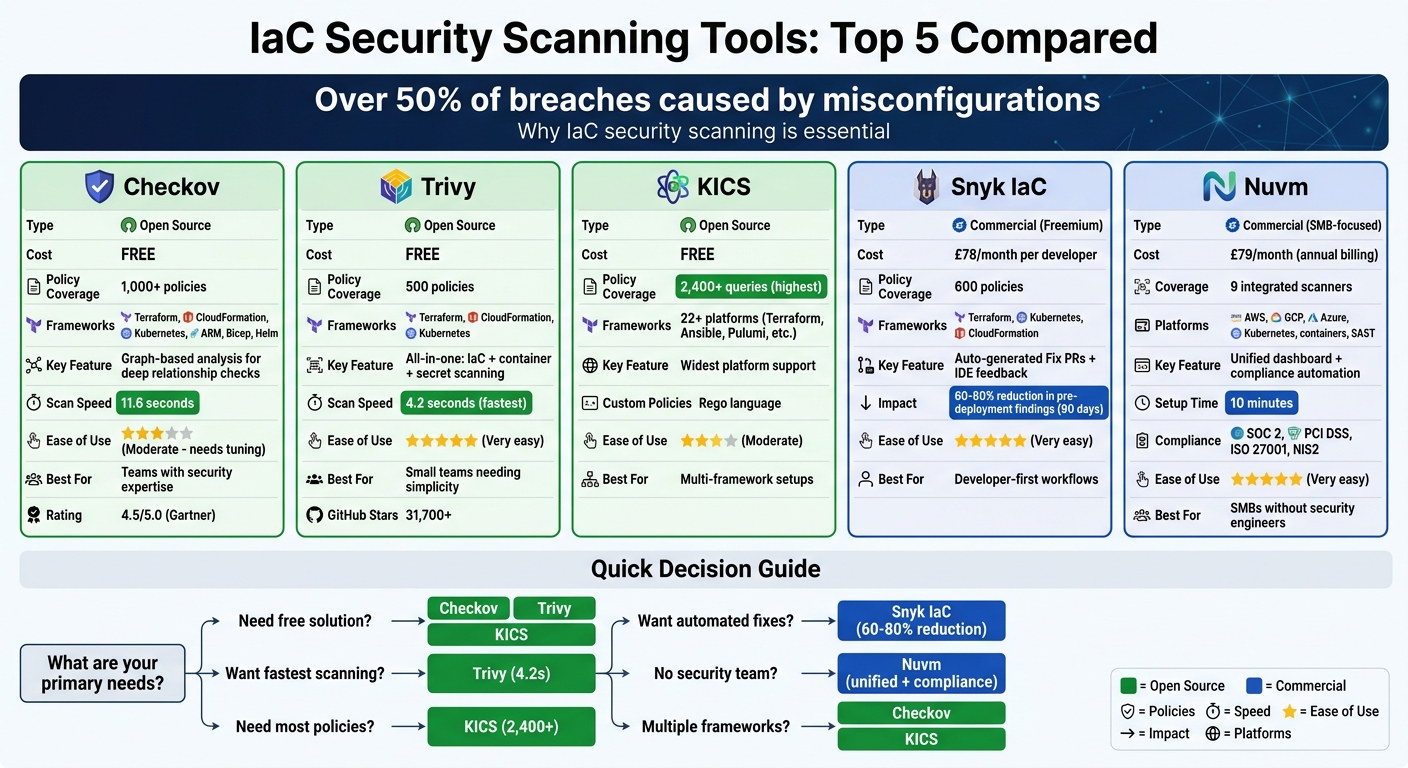
IaC Security Scanning Tools Comparison: Features, Pricing, and Best Use Cases
Scanning Infrastructure as Code (IaC) for vulnerabilities
5 IaC Security Scanning Tools Compared
Let’s dive into a comparison of five Infrastructure as Code (IaC) security tools: three open-source options (Checkov, Trivy, KICS), one commercial tool aimed at developers (Snyk IaC), and a unified solution designed for small-to-medium businesses (Nuvm). Each tool was assessed based on its supported frameworks (e.g., Terraform, CloudFormation, Kubernetes), ease of integration, detection abilities, remediation features, and suitability for smaller teams without dedicated security personnel.
The open-source tools shine in terms of policy coverage and affordability, while the commercial options focus more on user experience and automation. For example, Checkov offers over 1,000 built-in policies and uses graph-based analysis to check relationships between resources, such as ensuring an EC2 instance is connected to the correct VPC. Trivy, on the other hand, combines IaC scanning with container and secret detection in one tool, reducing the need for multiple solutions. Meanwhile, KICS supports over 22 platforms with an impressive library of 2,400+ queries.
On the commercial side, Snyk IaC stands out for its developer-friendly features, like inline IDE feedback and automated pull requests to fix vulnerabilities. These capabilities can cut pre-deployment findings by up to 80% within 90 days. Nuvm, designed for SMB SaaS teams, offers a unified dashboard that integrates results from nine scanners, making it easier for teams without security experts to manage compliance and security.
"The best scanner is the one your team actually uses consistently. A perfectly configured multi-tool pipeline that developers disable because it is too slow or too noisy provides zero security value."
– Suphi Cankurt, Founder, AppSec Santa
Here’s a closer look at each tool.
Checkov
Checkov, created by Palo Alto Networks, is a Python-based IaC scanner known for its extensive policy coverage. It supports frameworks like Terraform, CloudFormation, Kubernetes, and Ansible, among others. Its standout feature is graph-based analysis, which validates complex resource relationships - for instance, ensuring an EC2 instance is connected to the right security group or VPC.
With over 1,000 built-in policies (800 of which are graph-based), Checkov aligns with industry standards like CIS benchmarks, SOC 2, and PCI DSS. It integrates easily into workflows via the CLI, GitHub Actions, or Docker, and allows custom policies to be written in Python or YAML. However, initial scans can produce a lot of noise and may require tuning. Its deeper analysis takes about 11.6 seconds, compared to Trivy's faster 4.2-second scans.
"Checkov is the default starting point for Terraform IaC security - the largest open-source ruleset (1000+), multi-cloud support, CI/CD native, and free."
– Suphi Cankurt, Founder, AppSec Santa
Checkov is open source under the Apache 2.0 licence and has a 4.5/5.0 rating on Gartner.
Trivy
Trivy, developed by Aqua Security, is a Go-based scanner that expanded its capabilities in 2023 by integrating tfsec. It now offers IaC checks alongside container image scanning, SBOM generation, secret detection, and Kubernetes cluster scanning - all within a single binary. This all-in-one approach is especially appealing to teams looking to simplify their security stack.
Trivy is quick to set up, requiring no configuration for basic use, and integrates seamlessly into CI/CD pipelines. It supports Terraform, CloudFormation, and Kubernetes, with around 500 IaC-specific policies. Its fast scanning speed (4.2 seconds per scan) and straightforward usability make it a strong choice for smaller teams. However, since Trivy relies on attribute-based scanning rather than graph-based analysis, it may miss some complex cross-resource vulnerabilities that Checkov would catch.
With over 31,700 GitHub stars, Trivy has a strong community following, making it a reliable option for teams already using it for container scanning.
KICS
KICS (Keeping Infrastructure as Code Secure) by Checkmarx supports more than 22 platforms and boasts a library of over 2,400 queries. It covers a wide range of frameworks, including Terraform, CloudFormation, Kubernetes, Ansible, and Helm, making it suitable for teams managing diverse infrastructure.
KICS generates detailed reports with severity breakdowns and explanations for each issue. Like Trivy, it uses attribute-based scanning, prioritising speed and breadth over deep analysis of resource relationships. Custom policies are written in Rego (the Open Policy Agent language), which can be more challenging to learn compared to Checkov’s Python or YAML options.
KICS integrates with the CLI, Docker, and GitHub Actions. It’s fully open source under the Apache 2.0 licence, making it accessible for teams handling multiple IaC frameworks.
Snyk IaC
Snyk IaC is designed with developers in mind, offering features like inline IDE feedback (compatible with VS Code and IntelliJ), CLI integration, and CI/CD pipeline support. This "shift-left" approach helps teams identify vulnerabilities early in the development process, before they reach production. Snyk supports Terraform, Kubernetes, and CloudFormation, with around 600 policies.
One standout feature is the "Fix PRs" capability, which automatically generates pull requests with code changes to resolve vulnerabilities. This can significantly reduce manual remediation work, cutting pre-deployment findings by 60–80% within 90 days.
The main drawback is its pricing. The free tier is limited to five projects and a fixed number of monthly tests, while paid plans start at around £78 per developer per month.
Nuvm
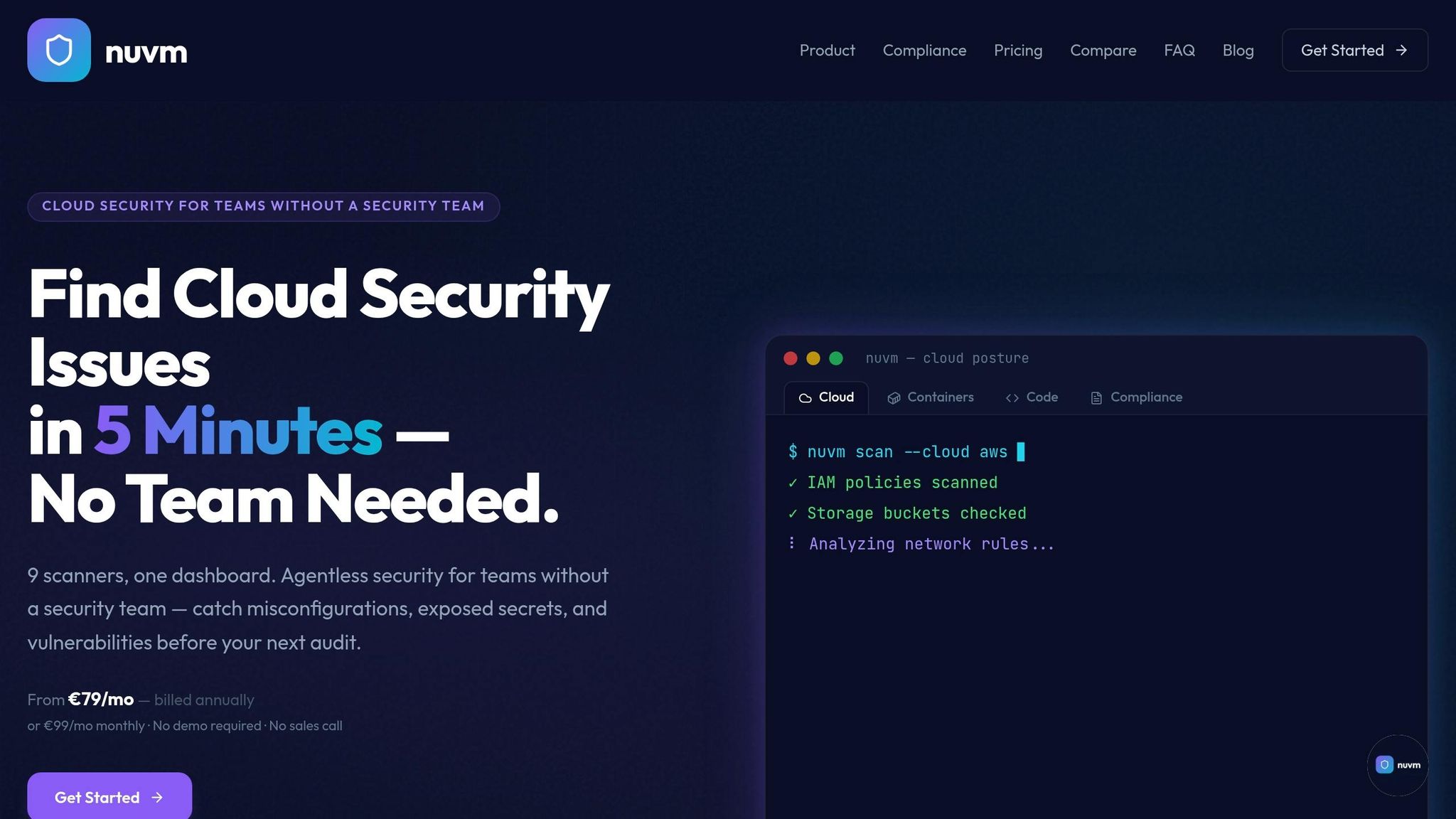
Nuvm is tailored for SMB SaaS teams that lack dedicated security engineers. Instead of focusing solely on IaC, it provides a unified dashboard that aggregates results from nine scanners, covering areas like cloud security posture management (AWS, GCP, Azure), containers, SAST, secrets, dependencies, IaC, Kubernetes, and web vulnerabilities. This consolidation reduces the need for multiple tools, making it easier for smaller teams to manage security.
Nuvm emphasises ease of use, with a quick 10-minute setup and plain-English remediation guidance. It also automates compliance mapping to standards like SOC 2, PCI DSS, ISO 27001, and NIS2, simplifying audit report generation. Pricing starts at £79 per month, making it an affordable option for SMBs looking for a comprehensive security solution.
Feature Comparison Table
Comparison Table
Here's a quick breakdown of key features across various tools to help you find the best fit for your team.
| Tool | Supported Frameworks | Pricing | Integration Ease | Policy Coverage | Remediation Guidance | SMB Suitability |
|---|---|---|---|---|---|---|
| Checkov | Terraform, CloudFormation, Kubernetes, ARM, Bicep, Helm, Dockerfile, Serverless Framework, AWS CDK, OpenTofu | Free (Open Source) | Moderate – needs tuning to reduce noise; native SARIF output for CI/CD | Extensive built-in checks | Policy descriptions with links to docs | Moderate – best suited for teams with some security expertise |
| Trivy | Terraform, CloudFormation, Kubernetes | Free (Open Source) | Very easy – single binary with minimal setup | Basic IaC-specific policies | Basic explanations with severity ratings | High – minimal setup required |
| KICS | 22+ platforms, including Terraform, CloudFormation, Kubernetes, Ansible, Pulumi, Knative, OpenAPI | Free (Open Source) | Moderate – available via CLI, Docker, and GitHub Actions; custom policies require Rego | Over 2,400 queries | Detailed reports with severity breakdowns | Moderate – strong for diverse infrastructure setups |
| Snyk IaC | Terraform, Kubernetes, CloudFormation | Freemium – paid plans from £78/month per developer | Easy – inline IDE feedback (VS Code, IntelliJ), CLI, and CI/CD integration | Robust policy library | Auto-generated "Fix PRs" reducing pre-deployment findings by 60–80% | Very high – developer-first design, minimal security expertise needed |
| Nuvm | Terraform (IaC scanning integrated into a unified platform) | £79/month (annual billing) | Very easy – 10-minute setup with unified dashboard | IaC coverage using integrated scanners | Plain-English remediation guidance and automated compliance mapping | Very high – tailored for SMBs without dedicated security teams |
Checkov stands out with its broad framework compatibility and extensive policy library, making it a strong choice for teams handling varied infrastructure. Trivy simplifies operations with a single binary that covers IaC, containers, and SBOMs, helping reduce tool sprawl. KICS offers wide platform support and over 2,400 queries, making it ideal for diverse setups.
Snyk IaC shines as the most developer-friendly option, featuring inline IDE feedback, CLI, and CI/CD integration, along with automated "Fix PRs" that can slash pre-deployment issues by 60–80% within a few months. Meanwhile, Nuvm consolidates multiple scanners into one platform, offering compliance automation and straightforward remediation guidance, all at a transparent cost.
This table summarises earlier discussions, providing a clear comparison to guide small-to-mid-sized SaaS teams. While open-source tools like Checkov and KICS offer robust coverage, they often demand more manual effort for compliance and remediation tracking. On the other hand, commercial tools focus on automation and user-friendly experiences.
Use this as a quick reference before diving into the detailed criteria for selecting the tool that aligns best with your team's needs.
sbb-itb-5d9b290
How to Choose the Right Tool
Picking the best IaC security scanner depends on three main factors: the frameworks you work with, your team's familiarity with security practices, and how much manual configuration your team can handle. For instance, if your team exclusively uses Terraform, you might prioritise tools that are optimised for speed and precision. On the other hand, teams juggling multiple frameworks like Terraform, Helm, and Ansible should look at multi-framework tools such as Checkov or KICS. Start by checking which frameworks each tool supports to ensure compatibility.
Framework coverage is a big deal. Make sure the tool supports your specific stack, whether that's Kubernetes, CloudFormation, Dockerfiles, or something else. For example, Checkov offers over 1,000 built-in policies, while KICS boasts more than 2,400 queries spanning 22+ platforms. If speed and ease of integration are priorities, Trivy might be a strong choice, as it comes as a single Go binary and requires no runtime dependencies.
Another important factor is developer experience. Tools with IDE plugins can significantly cut down on pre-deployment issues - by as much as 60–80% within the first 90 days. For instance, Snyk IaC provides inline feedback in VS Code and automated "Fix PRs". Meanwhile, open-source tools like Checkov and Trivy can identify up to 80% of misconfigurations without any cost.
Compliance mapping is where some tools stand out. If meeting standards like SOC 2, HIPAA, or ISO 27001 is part of your requirements, make sure the tool maps its findings directly to these frameworks. Since over half of breach incidents are tied to misconfigurations, it’s crucial to scan every change rather than relying on sporadic audits.
When starting out, consider using a "soft-fail" mode. This approach flags issues without blocking merges, giving your team time to fine-tune false positives while still keeping up with development speed.
Conclusion
Securing Infrastructure as Code (IaC) is no longer a "nice-to-have" – with nearly 25% of cloud security incidents linked to misconfigurations, it's become a necessity. The tools discussed here each bring something different to the table: Checkov provides over 1,000 built-in policies and supports a wide range of formats, making it a strong choice for power users. Trivy is ideal for teams focused on Terraform, offering reduced noise and targeted scanning. KICS stands out with its support for formats like Ansible and OpenAPI, while Snyk IaC caters to developers with its fix suggestions and priority scoring system. Choosing the right tool depends on aligning these features with your team's specific workflows and requirements.
For smaller SaaS teams or those without dedicated security engineers, Nuvm is designed to simplify the process. It combines nine integrated scanners, automated compliance mapping for SOC 2 and ISO 27001, and plain-language remediation guidance. This makes it especially appealing for teams balancing development and security without the luxury of deep technical expertise. By reducing alert fatigue, Nuvm aims to make security more manageable.
Ultimately, your decision will hinge on factors like your technology stack, your team's familiarity with security concepts, and how much manual setup you're prepared to handle. Tools like Checkov and Trivy offer excellent free options, while commercial solutions such as Snyk IaC and Nuvm focus on ease of integration and usability - particularly beneficial for small-to-mid-sized SaaS teams.
Whichever tool you choose, integrating it early in your CI/CD pipeline is key. Scanning pull requests allows you to catch and fix issues quickly, when they're easiest (and cheapest) to resolve. Starting with a "soft-fail" mode can help your team adjust to the tool, fine-tune false positives, and gradually build confidence before enforcing stricter checks.
FAQs
When should we run IaC scans in our CI/CD pipeline?
To keep your infrastructure secure, run IaC scans in your CI/CD pipeline before making any changes. This helps catch misconfigurations, vulnerabilities, and policy violations early in the process. Adding these scans at key stages, such as during pull request reviews or before deployment, allows you to spot and address potential issues right away. This proactive approach minimises the risk of deploying insecure or non-compliant infrastructure and ensures your IaC practices remain robust and secure.
How can we reduce false positives and alert noise from IaC scanners?
Reducing false positives and cutting down alert noise in Infrastructure as Code (IaC) scanners often involves fine-tuning detection rules. This means adjusting or suppressing rules that tend to generate frequent false alarms. Pairing behavioural analysis with signature-based detection can also help by distinguishing harmless activity from actual threats.
Another effective approach is creating custom whitelists for data that's already been verified as safe. By focusing on contextual prioritisation, teams can filter out irrelevant alerts, making it easier to zero in on genuine security risks that truly demand attention.
What’s the difference between graph-based and attribute-based IaC scanning?
Graph-based Infrastructure as Code (IaC) scanning works by creating a map of infrastructure components and their relationships. This method helps uncover complex misconfigurations and dependencies by analysing how resources interact. By doing so, it provides a broader understanding of the infrastructure, making it easier to spot security issues with greater precision.
On the other hand, attribute-based IaC scanning focuses on evaluating specific resource attributes - such as tags or permissions - against a set of predefined rules. This approach is more straightforward and targeted, making it ideal for quick assessments or ensuring compliance by concentrating on individual resource properties.