Container Security vs Application Security: Key Differences
Container Security vs Application Security: Key Differences
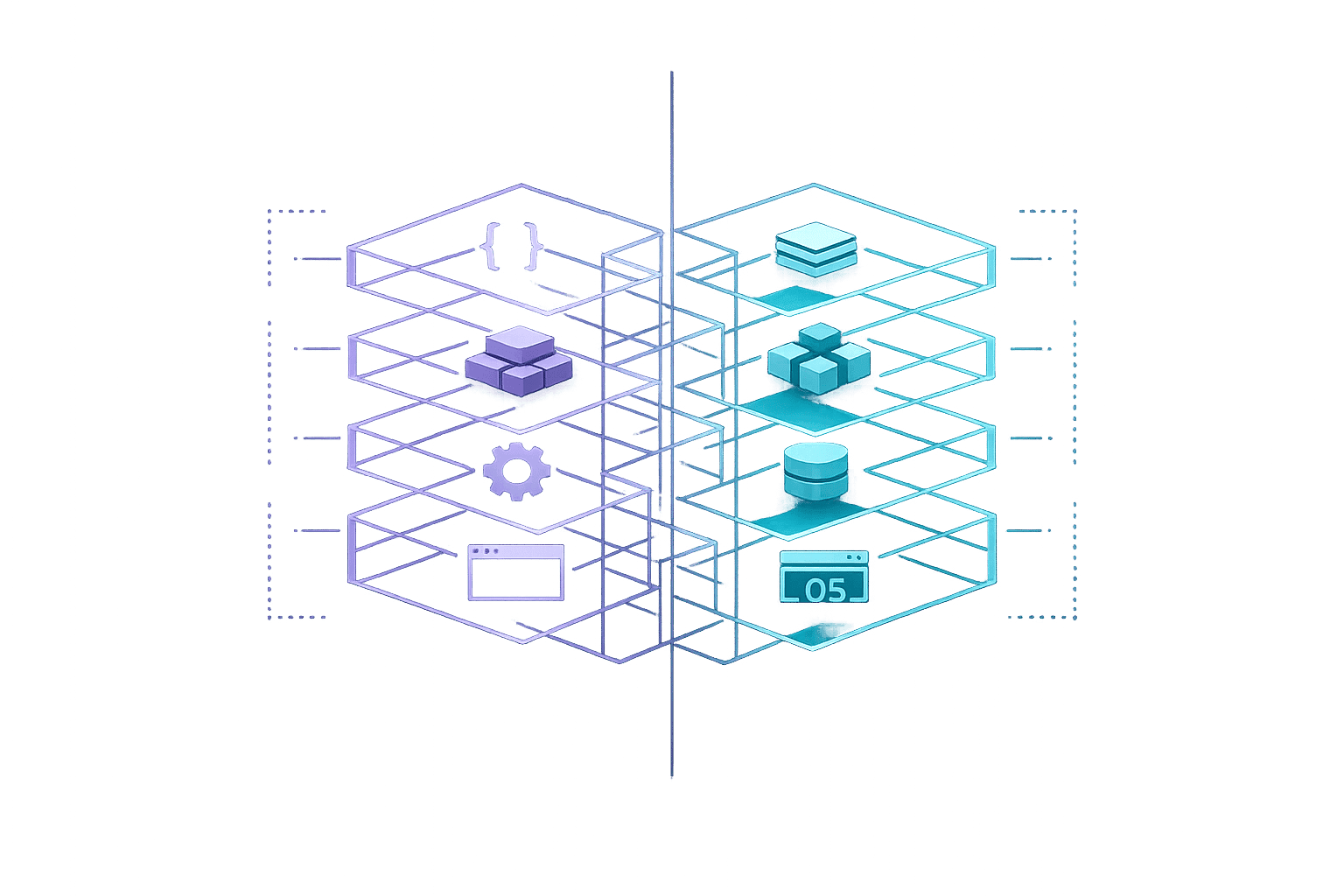
Container security and application security are two distinct but complementary approaches to safeguarding software. Here's the main difference:
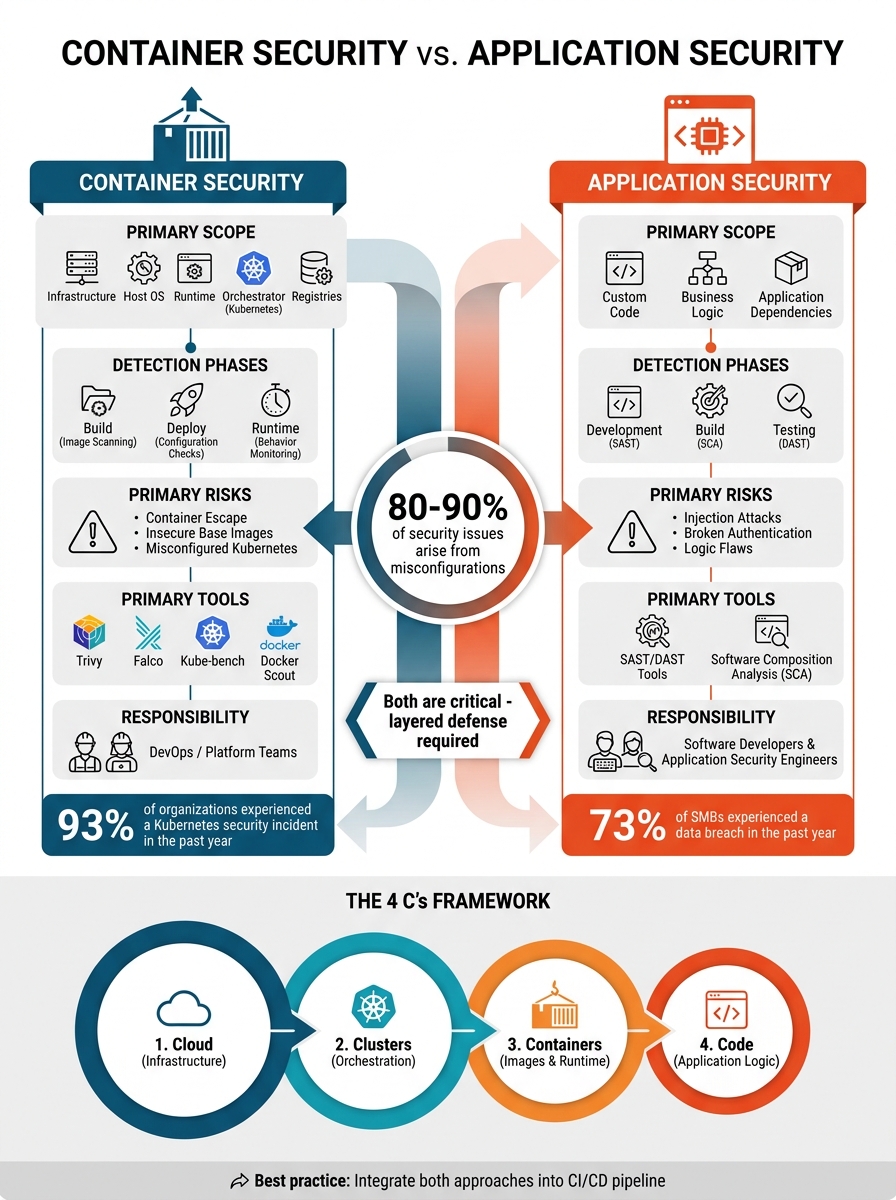
- Container Security: Focuses on the infrastructure layer - protecting container images, runtime environments, and orchestration platforms like Kubernetes. It addresses risks like container escape, misconfigurations, and vulnerabilities in base images.
- Application Security: Targets the codebase, including business logic, APIs, and dependencies. It mitigates risks like injection attacks, broken authentication, and exposed secrets.
Both are critical for modern SaaS teams, especially small-to-mid-sized businesses (SMBs), where misconfigurations cause 80–90% of cloud-native security issues. Combining these approaches creates a stronger defence.
Key Takeaways:
- Container Security: Scans images, monitors runtime behaviour, and secures Kubernetes configurations.
- Application Security: Detects code vulnerabilities, manages dependencies, and protects secrets.
- Automation: Integrating security tools into CI/CD pipelines allows small teams to identify and fix issues early.
Quick Comparison:
| Feature | Container Security | Application Security |
|---|---|---|
| Scope | Infrastructure, runtime, Kubernetes | Codebase, APIs, dependencies |
| Risks Addressed | Container escape, misconfigurations | Injection attacks, logic flaws |
| Tools Used | Trivy, Falco, Kube-bench | SAST, SCA, secret scanners |
| Responsibility | DevOps/platform teams | Developers/security engineers |
A layered approach - securing both infrastructure and code - is the best way to protect against modern threats.
Container Security vs Application Security: Key Differences and Scope
What's the difference between container and SCA vulnerability scanning?
sbb-itb-5d9b290
Container Security: Protecting the Infrastructure Layer
Container security focuses on safeguarding the infrastructure where applications operate. This includes everything from the base operating system in Docker images to the Kubernetes configurations that orchestrate workloads.
Containers, however, bring unique challenges. Each image layer - from the OS to the application code - can harbour vulnerabilities. For example, a scan of the python:3.10.12-slim image uncovered 39 vulnerabilities, including 2 categorised as Critical. Beyond these known vulnerabilities, containers are also exposed to supply chain risks, such as "image squatting." This occurs when attackers upload malicious images with names resembling popular ones, tricking developers into using compromised code. Below, we'll explore how to secure container images, monitor runtime activity, and strengthen Kubernetes configurations.
Scanning Container Images and Dependencies
Scanning container images is a crucial step before deployment. By integrating scanning tools into your CI/CD pipeline, you can identify vulnerabilities early, making them easier and cheaper to address. Tools like Trivy and Grype can detect issues in base images and dependencies, prioritising fixes based on CVSS scores to tackle the most severe risks first. Always pull base images from trusted, official registries and verify them using cryptographic signatures. Tools like Copacetic (Copa) can even patch operating system package vulnerabilities directly within images, saving the need to rebuild the entire application. To further reduce risks, configure containers to run as non-root users and avoid granting root access, which can help prevent container escape attacks.
Detecting Runtime Threats
While image scanning addresses risks during the build phase, runtime monitoring is essential for catching threats during operation. Static scans only identify known vulnerabilities; runtime monitoring adds real-time detection of anomalies such as unusual process executions, unexpected file access, or suspicious network activity. Tools like Falco can establish behavioural baselines and alert you to deviations, such as privilege escalation attempts, cryptojacking, or lateral movement within a cluster. Containers are inherently ephemeral, spinning up and down frequently, so maintaining real-time visibility is key to spotting active threats. Runtime monitoring also helps detect resource misuse, like sudden CPU or memory spikes, which could signal denial-of-service attacks. With the container security market expected to grow from £3.07 billion in 2025 to £25.51 billion by 2034, the demand for these capabilities is only increasing.
Securing Kubernetes and Container Configurations
Misconfigurations in Kubernetes remain a major security risk. Research shows that every Kubernetes cluster tested had at least one misconfiguration, while a 2023 CNCF survey revealed that 93% of respondents experienced at least one Kubernetes security incident in the past year. Common issues include containers running with root access, overly permissive RBAC settings, and missing network policies that allow unrestricted pod communication. Tools like Kube-bench and Kube-hunter can scan clusters against CIS benchmarks to identify these vulnerabilities. Recent breaches have highlighted the dangers of unsecured Kubernetes consoles. To mitigate these risks, enforce least privilege with granular RBAC, implement network microsegmentation, and use admission controllers like Kyverno to block pods that escalate privileges. Strengthening Kubernetes configurations is a critical step in building a robust security strategy for small and medium-sized teams.
Application Security: Protecting the Codebase
Application security zeroes in on safeguarding the code itself - the frameworks, libraries, and credentials that form the backbone of your software. The goal? Spot vulnerabilities before they make it to production. For SMB SaaS teams, catching these flaws early is critical to prevent the codebase from becoming a gateway for attackers.
A staggering 73% of SMBs experienced a data breach in the past year. Many of these breaches stemmed from avoidable code-level issues. The rise of AI-generated code has only amplified this risk, as automated tools can introduce exploitable vulnerabilities, which AI-powered attacks can then target. Let’s break down three core aspects of application security: identifying code vulnerabilities, managing dependencies, and safeguarding secrets. Together, these form a proactive approach to keeping your codebase secure.
Finding Vulnerabilities in Code
Common coding errors include memory safety issues, injection flaws (like SQL, XSS, and OS commands), access control gaps, and poor data validation. Tools like SAST (Static Application Security Testing) - for instance, Semgrep - can scan your code during development, flagging vulnerabilities before they’re committed. Additionally, language-specific linters, such as gosec for Go, provide another layer of defence by catching potential security bugs early.
As an example, research in 2025 revealed vulnerabilities in widely used TypeScript/Node libraries like "open", which could allow OS command injection on Windows if inputs weren’t properly sanitised. This highlights the importance of automated scanning tools. By focusing on the most critical security measures, you can address up to 80% of common risks.
But code flaws aren’t the only concern - external dependencies also pose significant risks.
Managing Dependencies and Supply Chain Risks
Dependencies, whether third-party libraries or APIs, often introduce vulnerabilities into applications. Application security covers language-specific packages (like npm for JavaScript or pip for Python), while container security addresses OS-level dependencies.
Software Composition Analysis (SCA) tools, such as Snyk or Trivy, can cross-check your dependencies against databases like the National Vulnerability Database. These tools help prioritise fixes based on severity. To minimise risks, regularly update libraries and avoid outdated or unsupported packages. Notably, 80–90% of security issues arise from misconfigurations. Automating dependency management and integrating it into your CI/CD pipeline can help prevent these problems.
Protecting Secrets and Credentials
Hardcoded secrets, such as API keys or passwords, remain a common weak spot. Alarmingly, 80% of hacking incidents involve compromised credentials, and credential abuse is the initial attack vector in 22% of breaches. To mitigate this, never embed secrets directly in your code. Instead, rely on environment variables or secure vaults like HashiCorp Vault, AWS Secrets Manager, or Azure Key Vault.
Incorporate secret scanning into your CI/CD pipelines and pre-commit hooks to catch exposed credentials early. Tools like GitHub’s secret scanning or Azure DevOps Credential Scanner can automatically detect and flag issues. Implement role-based access control (RBAC) to ensure that applications and developers have access only to the secrets they need. Automating credential rotation further limits the damage of a potential leak - dynamic secrets that expire quickly are especially effective in high-security settings.
"You can't leak secrets that don't exist." - Aembit
For SMBs without dedicated security teams, platforms like Nuvm offer a straightforward solution. Nuvm integrates secret detection into a unified dashboard, scanning repositories and pipelines for exposed credentials. It also provides clear remediation steps in plain English, making it easier for teams to address issues quickly. By combining this with automated compliance mapping for standards like SOC 2, PCI DSS, and ISO 27001, SMBs can maintain strong security practices without overburdening their teams. These measures, along with automated scanning, create a robust defence for your codebase.
Container Security vs Application Security: Side-by-Side Comparison
While both container and application security aim to safeguard software, they operate on different levels. Container security focuses on protecting the infrastructure, while application security deals with securing the codebase and its dependencies.
Here’s the catch: if the code itself has vulnerabilities, no amount of container security can fix that. Container security works across three stages: build-time (scanning images), deployment (verifying configurations), and runtime (monitoring behaviour). On the other hand, application security zeroes in on the development and build phases, using techniques like SAST (Static Application Security Testing) and DAST (Dynamic Application Security Testing). Since many issues stem from common cloud misconfigurations, automated scanning tools and proper configuration management play a key role in both areas.
The comparison below highlights how these approaches address different risks, offering a framework for a layered defence strategy.
Comparison Table
| Feature | Container Security | Application Security |
|---|---|---|
| Primary Scope | Infrastructure, host OS, runtime, orchestrator (e.g., Kubernetes), registries | Custom code, business logic, application dependencies |
| Vulnerability Detection Phases | Build (image scanning), deploy (configuration checks), runtime (behaviour monitoring) | Development (SAST), build (SCA), testing (DAST) |
| Primary Risks | Container escape, insecure base images, misconfigured Kubernetes | Injection attacks, broken authentication, logic flaws |
| Primary Tools | Tools like Trivy, Falco, Kube-bench, Docker Scout | SAST/DAST tools, software composition analysis (SCA) |
| Remediation | DevOps/platform teams | Software developers and application security engineers |
When it comes to resolving issues, the responsibility is divided. Container-related problems are usually handled by DevOps or platform teams, while application vulnerabilities are addressed by developers and security engineers. However, for smaller teams - where roles often overlap - integrated tools that cover both areas can be a lifesaver.
Using Both: A Layered Defence for SMB Teams
Container security protects the infrastructure, while application security focuses on the code. Overlooking either can leave your system vulnerable. Research indicates that 80% to 90% of security issues arise from misconfigurations. This means even the most secure code can be compromised if, for example, a Kubernetes cluster is poorly configured or a base image is outdated.
The best defence strategy is based on the 4 C's framework: securing Cloud (infrastructure), Clusters (orchestration), Containers (images and runtime), and Code (application logic). This layered approach ensures that even if one layer is breached, other barriers remain intact. As Michael Levan, AI Architect & Engineer, explains:
"If engineers could work with the developers from the start before the code was even packaged, it would help mitigate these security issues from the start".
This multi-layered defence highlights the importance of integrating security seamlessly across all parts of your stack.
Using Integrated Security Tools
For smaller teams without dedicated security engineers, unified platforms that bring together container scanning, code analysis, and secrets detection are a game-changer.
Take Nuvm, for example. It combines nine scanners - including cloud posture, containers, code, secrets, dependencies, IaC, Kubernetes, and web applications - into a single dashboard. This allows teams to identify a vulnerable dependency in their application code while also spotting a misconfigured Kubernetes pod, all without switching tools. On top of that, the platform provides plain-English remediation steps and automates compliance mapping for frameworks like SOC 2, PCI DSS, and ISO 27001. This is particularly useful for SMBs aiming to pass audits without hiring a dedicated compliance expert.
Prioritising Security with Limited Resources
When resources are tight, prioritisation becomes key. Small teams often juggle multiple responsibilities, so focusing on high-impact, automated security checks is essential.
Start with secrets scanning to ensure hardcoded API keys don’t make it to production. Next, add container image scanning to catch vulnerabilities in base images. These two steps tackle some of the most common weaknesses.
Using CIS-hardened 'golden' base images is another practical step. These are regularly scanned and provide a secure starting point. Combine this with enforcing least privilege through RBAC (Role-Based Access Control) to limit lateral movement within your system.
For those evaluating tools, lightweight open-source options like Trivy offer quick, low-configuration vulnerability scanning. Meanwhile, platforms such as Aikido Security - rated 4.9/5 on Gartner - offer a "Free Forever" tier alongside affordable flat-rate plans.
Automating Security in CI/CD Pipelines
Incorporating security early in the CI/CD pipeline - known as shift-left security - helps identify vulnerabilities when they’re easiest to fix. Automating tasks like image scanning, dependency checks, and secrets detection ensures every code commit triggers a security review. Data shows that 68% of developers already have access to CI/CD and automated testing, but embedding security into these workflows remains a challenge.
Using policy-as-code can help. This approach automatically blocks pull or merge requests if critical risks are detected, turning the CI/CD pipeline into a powerful enforcement tool.
Finally, runtime monitoring tools like Falco or Sysdig can detect zero-day threats and unusual behaviour, providing an extra layer of protection.
Common Mistakes and How to Avoid Them
When tackling container and application security, even the best teams can stumble into common traps. And these mistakes can be costly - fixing bugs in production is far pricier than catching them early on.
Don't Stop at Build-Time Security
Scanning container images during the build phase is a must, but it’s not the full picture. As Emma Datny points out, relying solely on runtime scanning is like locking the door after an intruder has already entered. While it takes an average of 38 days to patch a vulnerability, attackers often exploit new vulnerabilities in as few as 12 days.
Build-time scans are great for catching known vulnerabilities in static images, but they can’t spot zero-day threats or unusual behaviours that emerge once your application is live. Containers, by their nature, are short-lived - they spin up and shut down quickly. This makes it easier for attackers to carry out "fileless" attacks, which leave no trace once the container is terminated. To counter this, runtime monitoring tools like Falco can detect suspicious system calls and activities in real time, giving you critical visibility beyond what static scans can offer.
Next, let’s look at how poor secrets management can make these vulnerabilities even worse.
Managing Secrets Properly
One of the biggest blunders is hardcoding sensitive information like API keys, passwords, or certificates directly into container images or environment variables. This practice can expose credentials in version control systems, messaging platforms, or even documentation, making it easy for attackers to exploit.
A better approach is to use dedicated secrets management tools that inject credentials at runtime instead of embedding them into images. Additionally, regularly rotating encryption keys and certificates helps limit the damage if a credential does get exposed.
However, focusing on individual security components without considering the bigger picture can weaken your overall defence.
Treating Security as One Goal, Not Separate Silos
Perhaps the most dangerous mistake is treating container security and application security as separate, unrelated efforts. Lori Mac Vittie, Distinguished Engineer and Chief Evangelist at F5, puts it plainly:
"There is no room for silos when it comes to security"
When teams work in isolation, risks multiply. For example, a misconfigured Kubernetes API becomes far riskier when paired with a vulnerable application running inside it. Alarmingly, research shows that 94% of organisations experienced a security incident in their container and Kubernetes environments in the past year. Often, this happens because security responsibilities are fragmented across teams.
The best strategy is to treat security as a shared responsibility that spans the entire stack - from the host operating system and container runtime to the application code. Developers, operations, and security teams must collaborate early in the CI/CD pipeline, ensuring that speed doesn’t come at the cost of security. For smaller teams without dedicated security engineers, integrated platforms offering unified visibility across all layers can make this collaboration much easier.
Avoiding these common mistakes helps build a strong, layered defence - essential for small-to-mid-sized SaaS engineering teams.
Conclusion: Building a Complete Security Strategy
Container security and application security work hand in hand to create a robust defence. As Contrast Marketing aptly puts it:
"Placing an application within a container does not make the software less vulnerable nor does it protect it from attack"
Even the most secure code can fail if the container runtime is misconfigured or compromised.
With 70% of a typical container image consisting of open-source software and 62% of CISOs highlighting container runtime environments as a challenge for managing vulnerabilities, it’s clear that securing both the application code and the runtime environment is non-negotiable.
Addressing issues early in the development process is far more cost-effective than fixing problems after deployment. By integrating security checks into your CI/CD pipeline, you can scan both application code and container images before they are deployed. Adding runtime monitoring ensures that any threats emerging post-deployment are quickly identified and addressed. These measures form the backbone of a practical, proactive security strategy.
Key Takeaways for SMB Teams
- Start with trusted base images: Use verified and scanned base images before adding your custom code.
- Automate vulnerability scanning: Incorporate automated scans into your CI/CD pipeline to prevent unvetted code from reaching production.
- Apply least privilege: Configure containers to run with the minimal permissions required, avoiding risky settings like "privileged" flags that could endanger the host system.
- Secure secrets properly: Use dedicated tools for managing credentials instead of embedding them directly into images or environment variables.
- Harden your host system: Opt for lightweight, container-optimised Linux distributions to reduce potential vulnerabilities.
- Implement network microsegmentation: Restrict traffic between pods to only what is necessary, limiting the spread of potential breaches.
These practical steps help create a layered defence that safeguards your code and infrastructure without needing a large, dedicated security team. By focusing on these fundamentals, small and medium-sized teams can significantly strengthen their security posture.
FAQs
Should we secure containers or code first?
Securing code during development is crucial because any vulnerabilities in the code can carry over into containers. It's important to tackle code-level issues, manage dependencies carefully, and adopt secure practices right from the start. That said, container security is just as important, as it helps mitigate risks like image vulnerabilities and runtime threats. The best strategy is a layered one: start by securing the code to prevent potential issues, then focus on securing containers during deployment and runtime to safeguard workloads against new and evolving threats.
What should we scan in CI/CD vs monitor at runtime?
In CI/CD pipelines, it's crucial to prioritise scanning for vulnerabilities in container images, dependencies, and configurations before deployment. This involves conducting static analysis of both the code and infrastructure as code (IaC) to identify and address potential issues early in the development cycle.
Once the application is running, keeping an eye on its behaviour is equally important. Monitoring can help detect anomalies, problematic containers, or even malicious activity. This kind of dynamic monitoring provides real-time insights into potential threats or misconfigurations that might emerge during live operations, helping to uphold security and compliance standards.
How can we quickly reduce Kubernetes misconfigurations?
To cut down on Kubernetes misconfigurations effectively, prioritise visibility, compliance, and automation. Leverage tools to scan container images and configurations before deployment, adhere to CIS benchmarks, and implement strict access controls. Ensure you have real-time insights into active containers and embed vulnerability scanning directly into your CI/CD pipeline. These practices enable small-to-mid-sized teams to tackle misconfigurations efficiently, even without deep security expertise.